Event Instructions High jump and Long jump
The high jump and long jump competitions for all age groups take place on July 30th in the stadium from 8:00-12:00 and 15:00-19:00 with free start time. The tiebreakers for the age groups and the final and will be on July 31st.Spectators:
The jump competition promise to be very interesting because of optimizations in jump unicycles and jumping techniques in recent years.A special highlight will be the finals on July 31st during the 100km race. It will take place on the track immediately in front of grandstand. We expect new records in high jump and long jump
Participants:
Age group jump:
The Age group jump take place on the July 30th from 8:00-12:00 and 15:00-19:00 with free start time. High jump will be held at the stadium arches S3 and long jump at the final straight S7. Riders with the same height or length placing top 3 in any age group will go for tiebreakers next day.
Participants of the tiebreakers and finals will be published in the evening of July 30th at the result board.
Tiebreakers:
If a rider reaches the final and a tiebreaker too, his jumps will be valid for final and tiebreaker, so that the athlete must jump only once.
Otherwise the tiebreaker of the age group will be held directly before the final.
Finals:
Best of 8 highest / longest jumpers over all are qualified for the final on July 31th. Finals start with the discipline long jump, starting with sex female from 10:00 – 12:00 clock respectively immediately after the age group tiebreaker. The final high jump will held in the same sequence from 15:00 – 17:00 clock.
The finals start with following minimum heights / lengths:
high jump:
- female 45 cm
- male 75 cm
Long jump:
- female 180 cm
- male 250 cm
General:
In case of bad weather the competition will be held in the trials Hall T1.
There are 3 high jump and 3 long jump apparatuses available. They can used to carry out the competition at the same time and have different ranges.
High jump:
Area 1: up to 45 cm
Area 2: 41 cm to 80cm
Area 3: from 75cm
all riders are asked to jump them warm in the existing training equipment, so that they can start the competition in the apparatuses which is expected that they will reached the final height / length.
It is also possible to move to another apparatuses during the competition. For example the rider jumps in area 1 up to 41 cm and he expects that he will jump higher than 45 cm, he could decide by himself when he moves to area 2 in range 41 cm to 45 cm. After moving to area 2 he normally continues the competition with the next height.
Participants can choose which height they want to start with and they can also decide to skip a height.
Long jump:
area 1: up to 150 cm
area 2: 100cm – 220 cm
area 3: from 180 cm
the procedure on long jump will be the same as high jump.
Protective equipment:
In addition rulebook Shine-pads are required next to Helmet, knee pads and gloves.Age groups:
Female / male: 0-11, 12-14, 15-16, 17-18, 19-24, 25+Special features for long jump competition:
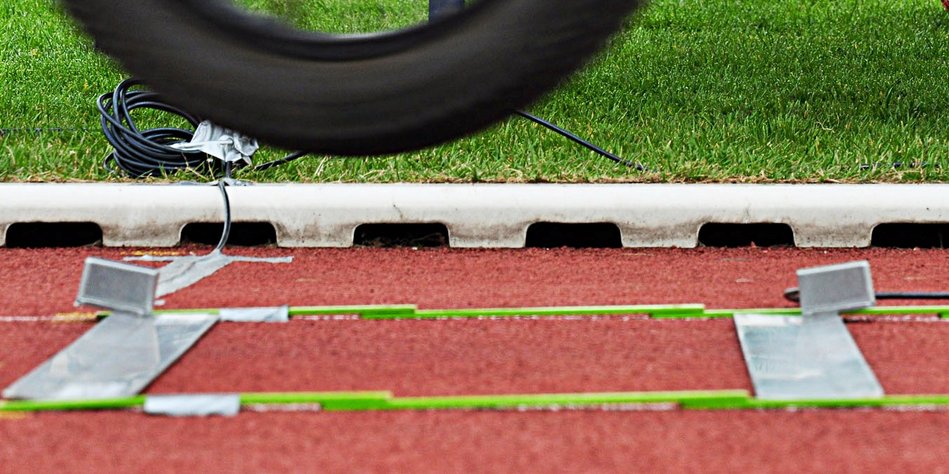
Jump marker and landing marker for the area 2 and area 3 will be additional monitored with electronic sensors. Because of technical reasons the makers must have a height up to 1 cm, see also separate description (see below).The start line will be 3 meters before the jump marker and the finish line is 6 meters behind the jump marker.
Both lines (start and finish line) must be ridden in correct way that the attempt will be valid.
Description for monitoring of the electronic long jump markers
In recent times an exactly evaluation of a long jump attempt will be very difficult. This is caused by extreme length and resulting high speed. A further problem is, if the rider fall it’s very dangerous for the judge by monitoring the attempt. To have a consistent and reliable possibility for the judge following new electronic detection system was developed and already successfully tested:On the jump and landing markers is a sensor with 2 channels mounted.
The measuring principle of the sensor is used in the automobile industry and is working in almost every car very well.
As soon as a slight touch at the marker happens, the sensitive sensor responses with a significant signal on both channels.
To prevent an incorrectly detected contact for example caused through a vibrating ground by normal landing it’s necessary to have a sensor with 2 channels and different orientation. Therefore such a misuse event can be distinguished to a normal contact of the marker.
The sensor signals will be displayed in each jump and the judge can immediately decide if the jump was correct or not.
Comment:
The markers have a thickness of 3mm, expectations from other competitions shows that such a thickness is necessary to have stability for example against a falling saddle. For correct working of the sensor principle with 2 channels in different orientations, it’s necessary, that the marker must have a slant with a minimum angel. Therefore in sum the markers have a height of 9 – 10 mm.
Picture of jump and landing marker with mounted sensors: